
Zhejiang Mingli Machine Technology Co, Ε.Π.Ε.
When people picture a bag making line, they usually picture the main machine. But on liquid bag, bag-in-box (BIB), and valve bag lines, the steps that follow bag forming — attaching valves, folding, sealing — are often where labor piles up and consistency slips. Intelligent robot accessories are built for exactly those steps. This guide explains what they are, what each one does, and how to tell whether your line actually needs them.
They are automated units that work alongside a bag making machine, taking over secondary operations that would otherwise be done by hand. They don't replace the main machine; they fill the gaps around it. Mingli's range covers three of these operations: valve adding, folding, and sealing.
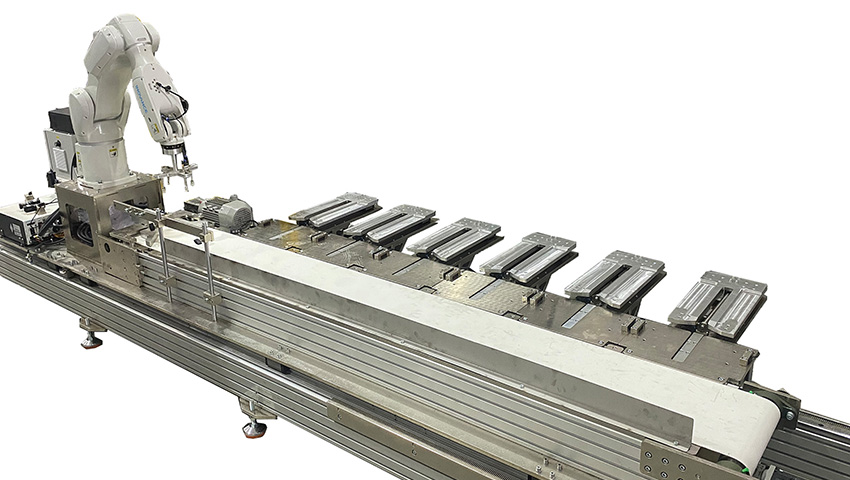
ML-911
| 1 |
CCD Visual Valve Adding RobotA high-speed CCD vision system identifies the valve position, and a servo-driven arm places the valve accurately. It suits liquid and powder packaging where positioning tolerance is critical. See the ML-911 for full specifications. |
| 2 |
Liquid Bag Folding RobotLiquid bags have complex folding requirements. This robot handles them so folds come out uniform and the bag holds a stable shape, ready for the next step. See the ML-2150 for details. |
| 3 |
Intelligent Bag Sealing MachineProgrammable logic control with real-time feedback and adaptive temperature control keeps seal strength consistent, and it is designed to work with high-speed lines. The ML-4500 handles large-format bags up to 4300mm wide. |
| Model | Job | Reference Figure |
| ML-911 | Valve adding (CCD vision) | 40 pieces per minute |
| ML-2150 | Liquid bag folding | 20 pieces per minute |
| ML-4500 | Intelligent bag sealing | Up to 4300mm width |
Three problems come up again and again on manual or semi-manual lines. Valve placement drifts, which raises the risk of leaks. Folding is slow and the finished shape varies from bag to bag. And seal quality depends heavily on operator experience. Automating these steps reduces dependence on skilled labor and makes output more consistent, which in turn makes the downstream steps easier to run.
The honest answer depends on what you produce.
You probably do if: you make liquid bags, BIB, or valve bags · manual steps have become your bottleneck · valve position or seal consistency directly affects your reject rate
You probably don't yet if: you mainly run simple flat bags without valves or folding steps · volumes are low enough that manual handling isn't a constraint
This links back to the sealing type you choose: our guide to three-side seal, four-side seal, and stand-up pouch machines explains how bag format shapes what the rest of your line needs.
Does the accessory's speed match your main machine's output, or will you need more than one unit?
Is it compatible with the bag making machine you already run, and does your floor plan have room for it?
Do you want it bundled with a new line, or added to an existing one? Mingli's robot accessories can be purchased separately, so retrofitting is an option.
Mingli's three accessories are aimed at the same applications as its liquid bag and BIB machines, and build on the company's experience with CCD vision positioning. Each can be bought on its own, so you can start with the one step that hurts most and add others later.
Not sure which accessory, if any, your line needs? Send us your bag type, output volume, and the steps that are still manual today, and we'll help you decide.
Get in Touch